









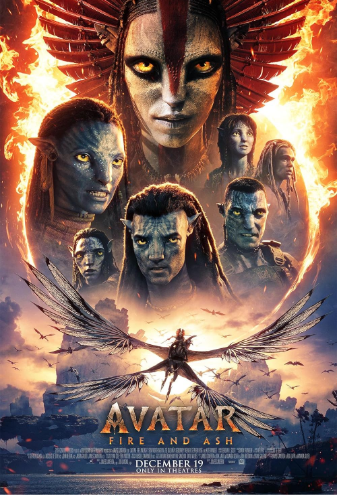
Around three years ago, director James Cameron took us on a cinematic journey to the bottom of the ocean in his transcendently crafted movie Avatar: Way of Water. Apparently, he liked it so much that he decided to stay. This past December 2025, the end of the iconic Avatar chronicles came to an end as a trilogy with Avatar: Fire and Ash. However, after watching the film myself, it’s clear that although the movie isn’t horrible, it’s a significant step backwards when compared to its two predecessors.
The original 2009 Avatar was built with groundbreaking CGI and a unique, engaging plot that still holds up today, especially impressive considering the time period. Its sequel, the Way of Water is also a personal favorite of mine, combining breathtaking views with a perfect, heartfelt story. Meanwhile, Fire and Ash gave me waves of déjà vu, with similar themes from the first two movies seemingly smushed together and copy pasted in a visual spectacle that we’ve all sort of seen before. Once again, when things start looking truly dire, Eywa (who we’ve still got no explanation for) shows up as a sort of cosmic dues ex machina to bail everyone out, Quaritch is back for the third time (and at this point is he an antagonist or a rash?), and an almost exact replica of the second movie’s final battle takes place for this movie’s supposed “climax.” And what is that final battle exactly? It takes place on the water with the Tulkun, despite the giant looming “Fire” in the movie’s title.
Besides being redundant, the movie also just doesn’t delve deep into its characters and plots as well as it could have; it just feels hollow. For the first time while watching an Avatar movie, I almost fell asleep. Jake is filled with grief and guilt which they direct towards Neteyam, which almost leads to his suicide, so I feel like Jake could’ve emphasized a lot better for his last remaining son who just wanted to save his friend with daddy problems (screw Spider, we’ll get to him in a bit). Quaritch and Varang end up hooking up, and as much as I love villainous connections, it sort of humanizes the antagonists too much, taking away from the sense of tension. Speaking of tension, no main characters were lost in the process of the movie, which brings us to the plot point of Spider. His “plot armor” has reached Batman levels of absurdity. In one of the film’s “tense” moments, Spider manages to survive a broken oxygen mask through what can only be described as a “breathing miracle” via Kiri and Eywa. Though this ended up being a solid plot point and ended up solidifying the Sully family’s overall bond, the end of the movie also features a universal acceptance of Spider by Eywa in the spirit tree by all the fallen members and ancestors of the Na’vi, which undermines the pure hatred they’ve explicitly expressed for humans since the first movie. OC much? This may be personal bias, as Spider indirectly led to the death of one of my favorite characters while saving his murderer, but maybe Neytiri was right to want to end him in the first half of the movie.
Not only that, but James Cameron’s team had a timely 13 years as prep before releasing a sequel, whilst the third iteration had more than a decade less than that. It’s apparent that these factors contribute to what makes the new movie seem so lackluster in turn. The visuals are still fantastic, but it’s more of a shiny “mid” grade movie carried by the CGI team, so if you’re here for the bioluminescent eye candy that fills your brain with endorphins, then you’ll be satisfied. However, if you’re here for a new story, this might not be the movie for you.