








In today’s modern world, when a life-threatening emergency occurs, you call 911. Ambulances arrive staffed with trained paramedics who provide life-saving care while transporting patients to the hospital to receive further care. Those few minutes in the back of an ambulance can mean the difference between life and death. Thanks to the skill and dedication of America’s medical professionals, countless lives are able to be saved.
However, prior to the mid 1960s, formal ambulance services as we know them today did not exist. If you needed immediate medical treatment, your best bet was rushed transportation in a police-operated ambulance. These services lacked sufficient care, leading to worsened injuries and even death — all things that possibly could have been avoided with adequate emergency care. For African Americans, the situation is even more dire. During this period of intense racial tensions, Black communities often faced discrimination from the overwhelmingly white police force. As a result, Black communities were often hesitant to rely on emergency transport, further limiting their access to emergency care.
In 1966, the National Academy of Sciences published a paper titled “Accidental Death and Disability: The Neglected Disease of Modern Society,” which exposed the inadequacies in America’s emergency medical system. It reported that about 50,000 deaths occur each year due to these inadequacies, as well as how African Americans were disproportionately impacted, as they had the least access to emergency services. This issue was especially prevalent in Pittsburgh’s Hill District, the city’s largest Black neighborhood.
The publishing of this paper highlighted the urgent need for improvements in emergency care. With a grant from the federal government, former ambulance driver Phil Hallen partnered with Dr. Peter Safar, a pioneering doctor known for creating CPR, to change emergency medical services. Hallen wanted to use this opportunity to increase employment opportunities for Pittsburgh’s Black community. He reached out to Freedom House Enterprises, a Black-owned non-profit organization aimed at improving black welfare, for partnership on the program. With Safar’s medical knowledge, their ideas sought to transform America’s ambulance services while fighting against racial inequalities.
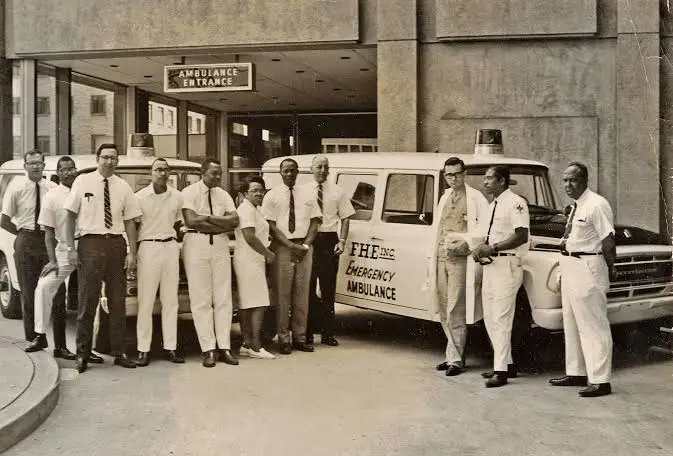
Following the development, in 1967, the first group of 26 potential paramedics were recruited from the Hill District, the majority of whom were young, African American men. These recruits had no prior knowledge of medicine. However, through the creation of a rigorous 300-hour long training program, Safar, with the help of three other doctors, trained the group on how to deliver first aid.
Soon after, the group was put to work. Called the “Freedom House Ambulance Service,” they delivered never-seen-before emergency care, with an average response time of less than 10 minutes. In the first year of operation, the paramedics answered nearly 5,800 calls, transported and cared for over 4,600 patients, and saved over 200 lives. Much of their service directly benefited Black communities, significantly improving access to emergency medical care. Their pioneering work laid the foundation for the modern Emergency Medical Technician (EMT) system in the United States.
Despite their success, however, the paramedics continued to face persistent racial prejudices. They were undermined and underestimated, with hospital staff disregarding their roles. White patients often refused service from the team. The Pittsburgh city government, seeing the success of the program, took over. They replaced the Black team with an all-white paramedic team, dismissing, firing, and reassigning the Black paramedics to non-medical work. They were placed in lower positions, being overseen by white supervisors with less experience.
The Freedom House Ambulance Service created a blueprint for today’s emergency and ambulance systems. African Americans were America’s first ever paramedics, and yet, like many pieces of black history, this contribution is largely overlooked. Black History Month, observed each February, calls attention to these forgotten achievements and emphasizes the importance of preserving and honoring Black contributions to American society. It is essential now more than ever to understand and remember the several contributions made by African Americans that make America what it is today.